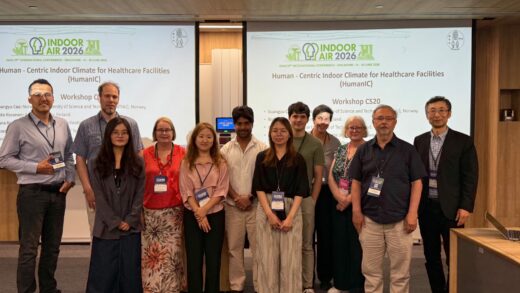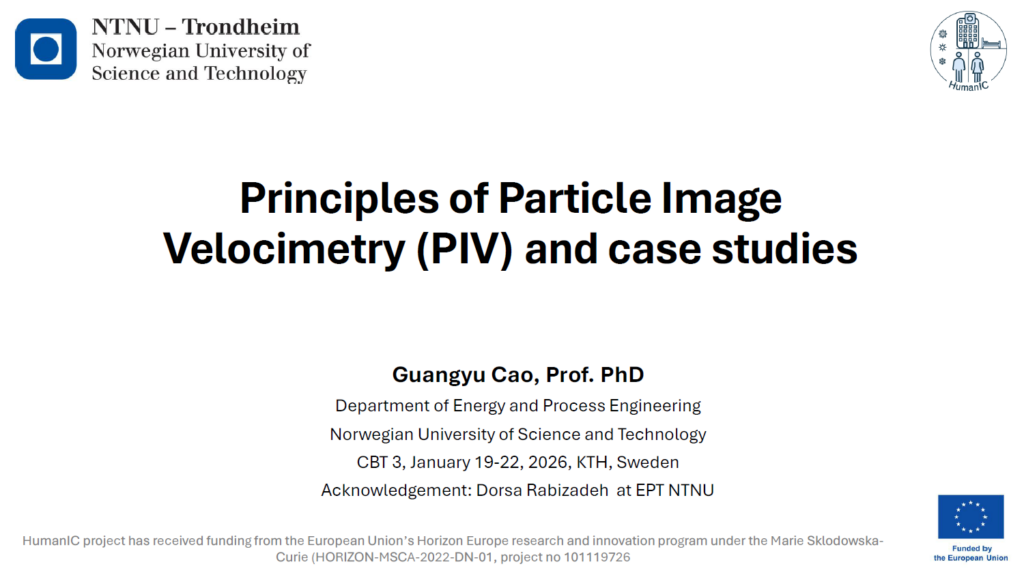
The presentation by Prof. Guangyu Cao addresses airflow distribution in operating rooms, illustrating how surgical lamps and equipment can significantly disturb laminar airflow. PIV is defined as a non-intrusive, whole-flow-field optical technique used to measure fluid velocity by tracking tracer particles illuminated by a laser sheet. The core principles described involve recording scattered light from these particles and calculating velocity vectors based on their displacement between laser pulses. The material covers critical technical factors, such as the use of Nd:YAG lasers and the necessity of maintaining a low Stokes number so tracer particles follow the fluid motion faithfully. Various seeding techniques for both gas and liquid flows are detailed, ranging from Laskin nozzle generators for oil droplets to helium-filled soap bubbles for larger viewing fields. The presentation examines PIV image processing and comparative case studies of ventilation systems, such as mixing versus laminar airflow, in simulated surgical scenarios.
The graphics accompanying this post were generated using artificial intelligence tools
.